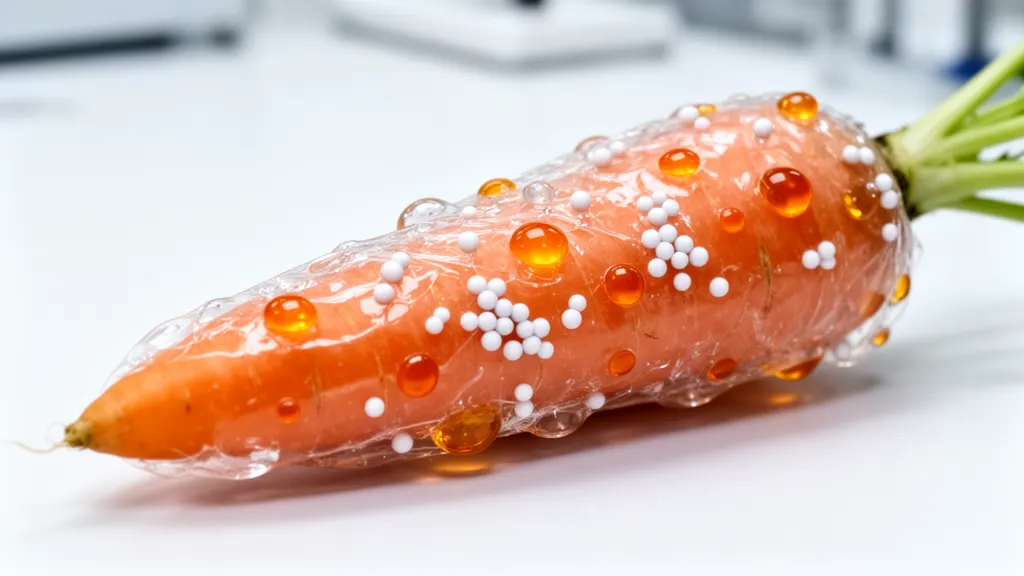
Fresh-cut produce loses water fast, and a new biocomposite film study puts a hard number on how much that can be slowed. Researchers combining chitosan, zinc oxide nanoparticles and orange peel essential oil reported that seven-day moisture loss in fresh-cut carrots fell from 43.50 percent to 5.80 percent under ambient storage conditions, according to a report in Bioengineer.org. For buyers of barrier and carrier films, the headline is less about carrots than about what a tuned film formulation can now claim on a specification sheet.
The formulation integrated one gram of zinc oxide nanoparticles and one milliliter of Citrus sinensis peel essential oil per one hundred milliliters of casting solution into an acetic acid chitosan matrix. Across a characterization battery comparing six distinct formulations, the dual-additive biopolymer showed pronounced improvements in barrier performance, ultraviolet light attenuation, antioxidant activity and bacterial inhibition relative to unmodified chitosan controls. Cumulative storage weight loss was suppressed by 86.67 percent compared with exposed unpackaged produce samples.
Why Neat Chitosan Was Never Enough
Chitosan, a linear polysaccharide built from beta-(1 to 4)-linked D-glucosamine and N-acetyl-D-glucosamine units, comes from deacetylating chitin recovered from crustacean shells. It brings natural biodegradability, biocompatibility and intrinsic antimicrobial function. But standalone chitosan films suffer poor mechanical strength and high moisture permeability, driven by microcracks that form as the solvent dries.
Adding orange peel essential oil alone is not a clean fix either. Nonpolar oil droplets tend to weaken interchain cohesion by raising molecular free volume. That is why the literature keeps returning to blending with synthetic water-soluble polymers such as polyvinyl alcohol, or to inorganic fillers, to shore up the film's structure. The carrot trial is a useful data point in that longer argument: mineral nanofillers plus botanical extracts inside a biopolymer framework can offset deficits that historically capped neat chitosan packaging.
The context matters commercially. Petroleum-based plastics used in food packaging account for nearly forty percent of global plastic usage, and the persistence of that waste in landfills and aquatic systems is the pressure behind most of this research. Biopolymers sourced from renewable agricultural resources and seafood processing residues are the proposed counterweight.
What This Means for PVA Film Packaging
Read as a materials signal, the study reinforces a direction that converters have been moving in for several years: the barrier layer is becoming a formulated product rather than a commodity sheet. For anyone specifying PVA film packaging — whether as a water-soluble carrier, a release layer or a component in a multi-layer compostable structure — the practical questions shift.
First, active additives change the qualification work. A film that claims UV attenuation or bacterial inhibition is no longer just a mechanical component; it may need its own documentation trail depending on the market and the end use. Second, dispersion quality matters. The chitosan result depended on getting inorganic particles and oil droplets distributed without wrecking interchain cohesion, and the same discipline applies to any water-soluble polymer blend. Third, end-of-life claims have to survive the whole construction, not just the headline resin.
There is also a reminder here for label specifiers working alongside film packaging. When a pack adopts a more active or more soluble film, the label adhesive and face stock are usually the last items re-checked and the first to fail in the wash or recycle stream. Moisture-barrier improvements at the pack level can change condensation behavior inside a package, which in turn affects how a label performs through chilled distribution. None of that is settled by a carrot trial, but it is the direction the questions will come from.
The Takeaway
A 43.50 percent to 5.80 percent moisture-loss reduction is a striking laboratory result, and the six-formulation comparison behind it gives the finding more weight than a single-sample demonstration. It does not by itself certify any commercial film, and the extract offers no cost, scale-up or migration data. What it does show is that the barrier conversation is moving toward combined mineral and botanical systems — and that PVA film packaging, as one of the established water-soluble building blocks in that space, will increasingly be judged on how well it plays with the rest of the formulation.
Source: Bioengineer.org