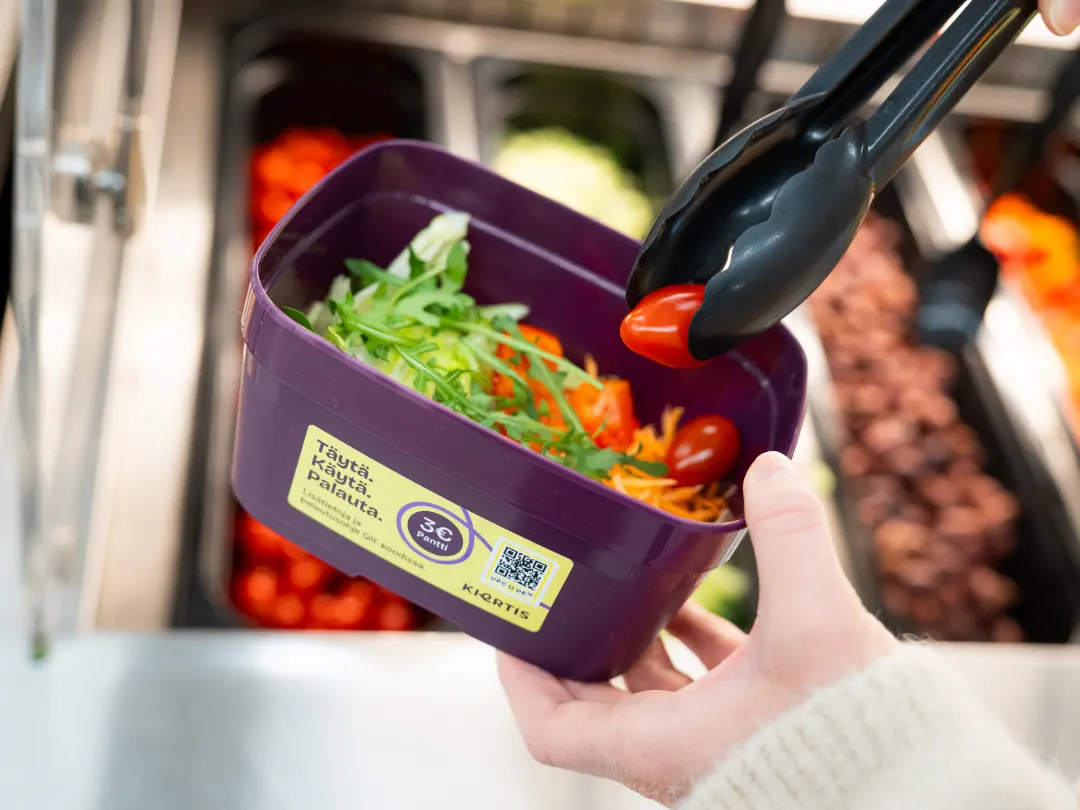
A shared reusable packaging system for takeaway food returned 65% of its containers during a three-month pilot across four supermarkets in the Helsinki region, according to results from the Reusify project. The trial, run by rival grocery retailers S Group and K Group, put the reuse cycle — collection, washing, quality control and reissue — through its paces in a live retail setting, and the headline number is the one packaging buyers should note: roughly two in three containers came back.
The project is coordinated by VTT Technical Research Centre of Finland with the University of Vaasa, backed by €2 million in research funding, and was developed in response to the EU's Packaging and Packaging Waste Regulation. Its stated aim is to build scalable reusable food packaging systems and test how well they perform across the value chain.
How the deposit pilot worked
Consumers choosing takeaway food could opt for a reusable container by paying a €3 deposit, which was refunded when the packaging was returned. The pilot covered the full loop rather than just the handover at the counter, tracking containers through washing and quality control before they went back into circulation.
Returned containers came back within seven days on average. Some consumers kept the containers for personal use — a signal of interest in the concept, but one that made tracking harder for the organisers.
Of the containers that completed washing, 91% passed quality control and were approved for reuse. That figure matters as much as the return rate: a reuse loop only holds together if the packaging survives washing and inspection often enough to justify the infrastructure behind it.
Participants familiar with the pilot reportedly saw reusable containers as a good alternative to single-use packaging and found the return system easy to understand. Ali Harlin, research professor at VTT, said the pilot showed that a reuse system can work in a supermarket setting. The next questions, he added, are whether it delivers genuine environmental benefits, whether consumer demand is sufficient, and which materials are best suited to repeated use.
Researchers at the University of Vaasa ran separate studies on whether personalising food containers encourages reuse and how packaging colour might influence consumer choices. Results indicated that certain design choices can influence behaviour, with some differences between countries.
What this means for label specification
For anyone specifying labels and backing materials, the Finnish trial is a useful reminder that reuse loops move the compliance burden downstream — onto every component attached to the container, including the label.
A container that is washed and inspected between uses puts its label through conditions a single-use pack never sees: repeated immersion, detergent, heat and mechanical handling. A reusable packaging system therefore tends to push buyers toward adhesives and face stocks that hold through wash cycles without flagging, lifting or leaving residue that fails quality control at the inspection station. Wash-off behaviour, long a specialty of ours in single-use returnable glass and PET lines, becomes a mainstream requirement rather than a niche one.
The 91% quality-control pass rate is the number to watch. Every container rejected after washing is a cost the reuse loop has to absorb, and label residue or adhesive transfer is one of the quieter reasons a unit gets pulled. As the EU regulation raises pressure on packaging producers to demonstrate reuse where it makes sense, expect buyers to ask for documented wash performance rather than generic "water-resistant" claims.
The open questions
Reusify has not yet answered the material question — which substrates and components are best suited to repeated use — and that gap is where most of the specification work will happen. Return rates also depend heavily on deposit levels and convenience, both of which retailers control rather than packaging suppliers.
For exporters watching European reuse policy, the practical takeaway is to start qualifying label constructions for multi-trip service now, so that when a customer's reuse pilot converts into a rollout, the label is not the component holding up the line.
Source: Packaging Europe