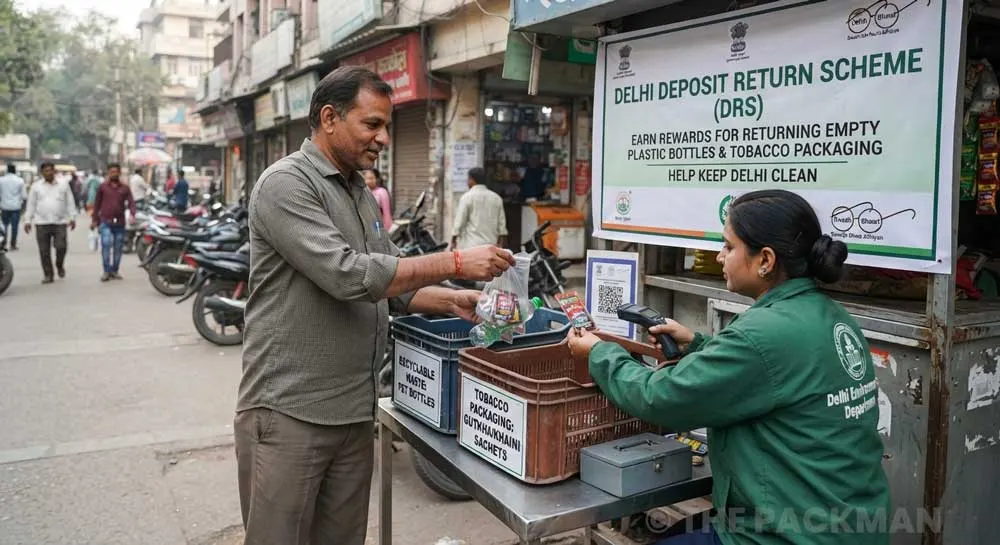
Delhi's environment department has been told to produce a full draft of a deposit return scheme within a month, and the scope is broader than most bottle bills: alongside PET bottles, the proposal would pull in packaging from tobacco products such as gutkha and khaini. For packaging and label buyers, the signal is that Indian regulators are moving toward putting a refundable value on the pack itself — not just the container everyone already associates with recycling.
What Delhi Is Actually Proposing
Environment minister Manjinder Singh Sirsa said the proposal was discussed with senior officials of the environment department, with deliberations centred on the policy framework and how it would be implemented, according to Press Trust of India.
The mechanics follow the standard deposit return model. A consumer pays a refundable deposit at purchase and gets the money back when the empty container or packaging is handed in at a designated collection centre or a participating retail outlet. The point of attaching money to the return is to lift collection rates and cut littering, landfill disposal and the flow of recyclable waste into drainage networks.
Sirsa has asked officials to prepare a comprehensive draft within a month. That draft is expected to weigh feasibility in Delhi's urban setting, funding arrangements, administrative mechanisms, implementation phases and the responsibilities of different stakeholders.
Officials are also studying models already running in India, including the deposit return framework in Himachal Pradesh. Similar systems operate in Goa and Uttarakhand, where state officials have reported improvements in material recovery. The minister has previously flagged plastic debris in soil and the toxic emissions from open burning of waste as the backdrop to the proposal.
Why the Tobacco Packaging Clause Matters
Extending a deposit return scheme packaging rule to gutkha and khaini packs is unusual, and it is the part most likely to complicate compliance. These are small, low-value, frequently discarded units, often multilayer laminates, sold through a dense network of small retailers. Collecting them back through the same retail channel that sold them is a logistical problem quite different from taking back a rigid PET bottle.
That distinction matters for anyone specifying labels and laminates for the Indian market. A deposit return scheme works on the assumption that the pack can be identified, counted and routed to a recovery stream. Where a label, adhesive or laminate blocks that — through contamination, inseparable layers or residue that fouls a wash or flake line — the pack becomes a cost rather than an asset in the system.
Officials cited figures showing deposit return systems are established in more than 40 countries, with collection rates in some international markets above 90% and reaching as high as 96%. Those numbers are typically achieved where the packaging stream is designed to be recovered, not retrofitted afterwards.
The Wider Direction of Travel
The Delhi proposal is still a draft instruction, not an enacted rule, and the one-month timeline covers drafting rather than rollout. But the direction is consistent with what exporters are already seeing elsewhere: regulators increasingly treat packaging as a material with a return obligation attached, and they are widening the definition of what counts as packaging waste.
For Delhi specifically, the stated aim is a more organised collection route for recyclable packaging and less burden on municipal waste management, bringing consumers, retailers, businesses and recyclers into one coordinated recovery system. Whether tobacco packaging can realistically be folded into that system is the open question the draft will have to answer.
What This Means for Label Specification
Our reading of the market, not a comment on this scheme's outcome: deposit return scheme packaging rules tend to reward specifications that keep a label separable from its substrate and compatible with whatever recovery line the pack ends up in. For PET, that has generally pointed buyers toward wash-off adhesives and soluble or dissolvable label stocks that release cleanly in a wash step, so the bottle re-enters the recycling stream without adhesive residue or fibre contamination.
For small flexible packs of the kind named in the Delhi proposal, the design problem is harder, because multilayer laminates are rarely built for separation. Buyers specifying for markets with deposit obligations should be asking earlier whether the label and adhesive choices will survive the collection and recovery route the pack is being signed up for — and should expect more jurisdictions to attach a financial value to getting the pack back.
Nothing here suggests the Delhi framework is settled. But a one-month drafting instruction is a reasonable prompt to review label and adhesive specifications against recovery requirements rather than against print performance alone.
Source: the packman