A water-soluble label is not a coating trick. It is a polymer engineered to give up its own structure on cue. Understanding how it does that explains most of the problems people hit in production.
1. Wetting
Water reaches the surface and starts to penetrate. Whatever sits on top of the polymer governs this stage — a varnish, a laminate, even a heavy ink coverage. A gloss varnish chosen for scuff resistance can push a forty-second release out to four minutes without changing anything you can see. If dissolution time drifts after a print change, look here first.
2. Hydration
Water molecules hydrogen-bond to the hydroxyl groups along the PVA chain and force the polymer network apart from the inside. The sheet swells and goes translucent. This is also why the stock is hygroscopic in the warehouse: the same mechanism runs slowly in humid air, which is why unopened, humidity-controlled storage matters and why web tension has to be lower than you are used to.
3. Disentanglement
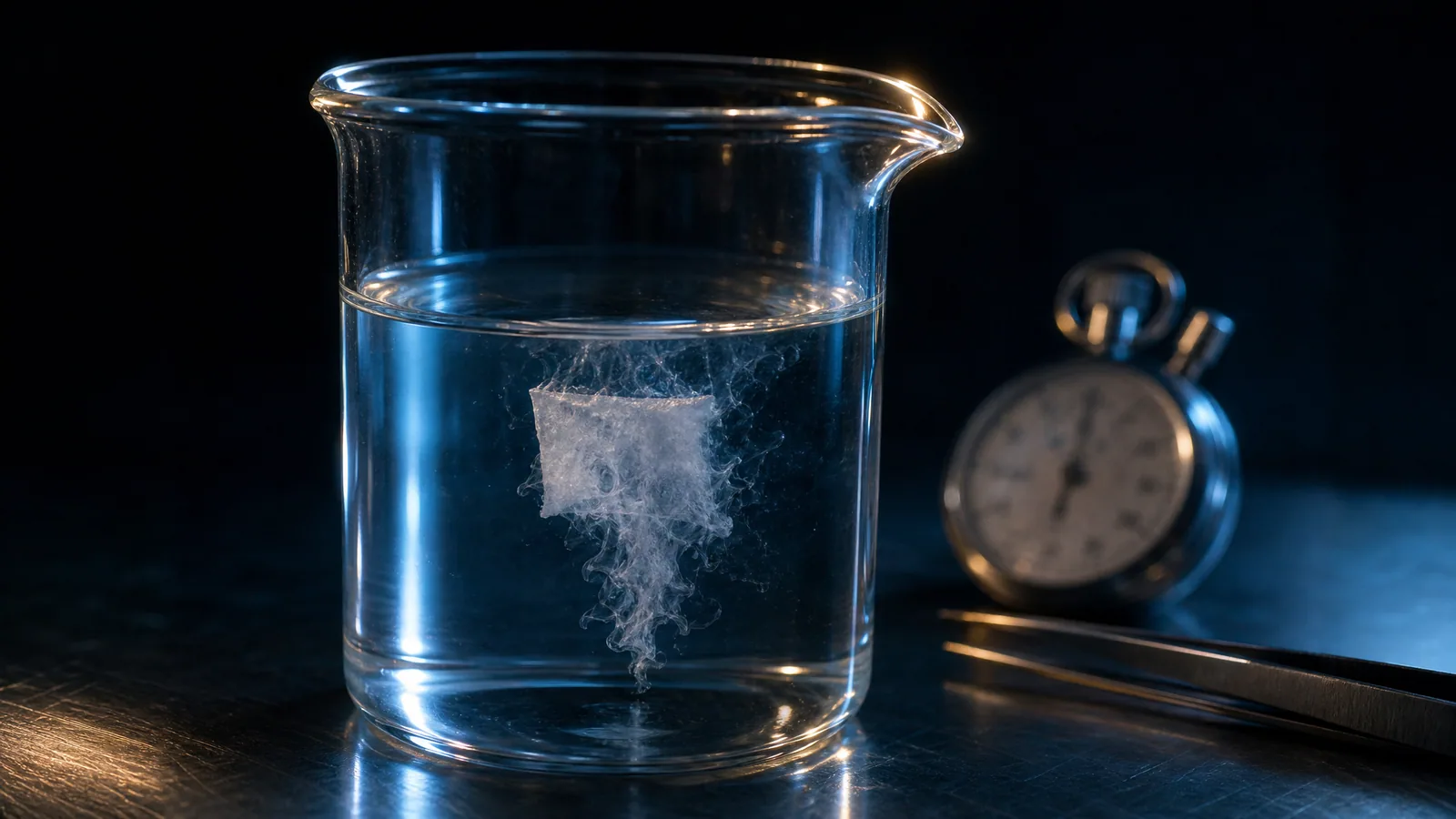
Swollen chains slide free of one another and the sheet loses cohesion. This is the moment a wash-off label releases in one piece — the face stock lets go of itself before it lets go of the glass. It is why a properly specified wash-off label floats off whole and can be screened out, rather than pulping and loading the filters.
4. Dispersion
Individual chains leave into solution. Nothing settles, nothing films on the container, and downstream the polymer is biodegraded by activated sludge in conventional wastewater treatment, ultimately to carbon dioxide and water.
What this means in the pressroom
Three practical consequences follow from the chemistry:
- Control humidity. The material must reach the press in specification. Sealed until it goes on, and staged in a controlled area.
- Lower the tension. Hydrated or partly hydrated stock stretches. Running it at conventional tension shows up as register drift long before anyone blames the substrate.
- Qualify the varnish, not just the ink. Any topcoat is a barrier at stage one. Test dissolution on the finished construction — printed, varnished, die-cut — not on the base stock.
The chemistry is forgiving of almost nothing at stage one and very forgiving after that. Get the surface right and the rest follows.